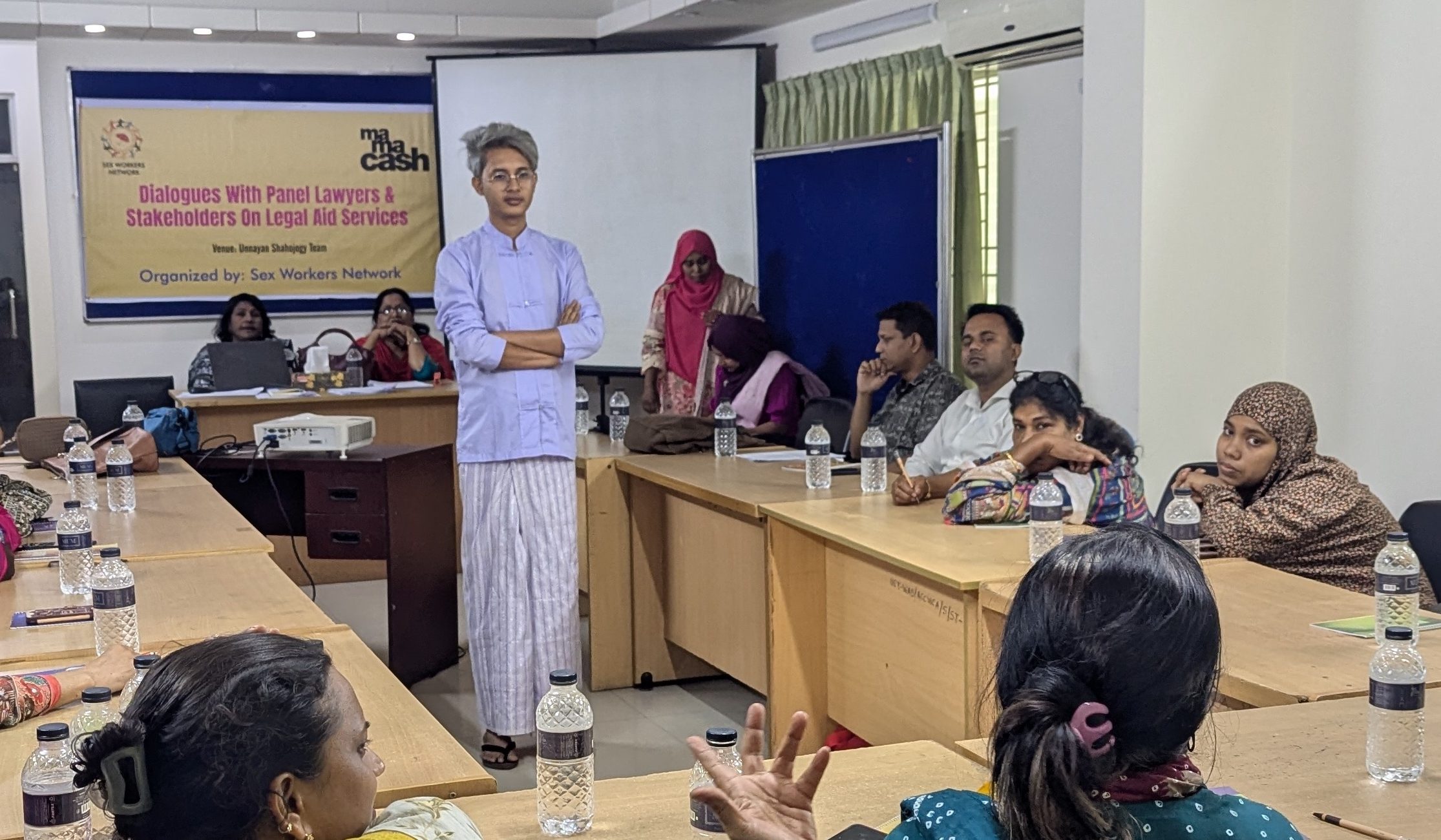
In April 2026, I sat in a room with women who had spent years navigating a justice system that was never designed to protect them. They shared their stories, their frustrations, and a cautious hope that someone was finally listening.
As I entered, one participant looked up and smiled, ‘Jabed Bhai, it has been so long.’ This was no coincidence. Both Rezwana Sultana, our Legal Officer, and I had worked with sex workers before. We walked in not as strangers, but with a shared history and a shared conviction that they deserve far better from the legal system.
The women we met were part of the Sex Workers Network (SWN), a national coalition of over 36 community-based organisations across Bangladesh, led by sex workers themselves. For years, they have organised, advocated, and supported one another in the absence of consistent institutional backing. What they have lacked is not resilience or leadership, but reliable access to legal support.
Their experiences point to a deeper contradiction in Bangladesh’s legal system. While adult female sex work is not explicitly criminalised, sex workers are routinely subjected to arbitrary arrest, police harassment, and charges that bear little relation to their actual circumstances. Laws intended to address trafficking or public order are often misapplied, disproportionately targeting those with the least power to challenge them.
As Nilufa, General Secretary of SWN, put it plainly:
‘I have seen cases where our members are charged with human trafficking or drug offences, while the client walks free. A woman goes to a hotel for sex work and comes out facing a trafficking case. She often does not even know what she has been charged with until she reaches the court.’
The numbers bear this out. When we asked the women in that room a simple question, “Is sex work illegal in Bangladesh?” not one of them answered correctly. These were not uninformed women, they were experienced, organised and had been navigating that system for years. What they lacked was not intelligence or resilience, it was access to the legal knowledge that should have been available to them. This is not a failure of individual actors alone. It reflects a broader, systemic gap between legal entitlement and legal access. Rights, in theory, mean little without the ability to exercise them. For many sex workers, that gap is reinforced by stigma, lack of documentation, and limited access to legal representation.
In April 2026, iProbono and SWN came together to explore what meaningful legal support could look like in practice. Around the table, women spoke candidly, about the weight of stigma they carry daily, about navigating institutions that treat them with suspicion, and about what it meant, simply, to be in a room where someone was asking and genuinely listening.
The partnership between iProbono and SWN is not about having all the answers, it is about walking alongside a community that already knows what it needs, and has been asking, loudly, for years. That means building relationships before building cases. It means showing up consistently, not just at moments of crisis. And it means designing legal support around the realities sex workers actually face, not the assumptions outsiders bring.
The conversations that afternoon were not abstract. Women spoke of living without National ID cards, unable to open bank accounts, access healthcare, or prove who they are in a court of law. They spoke of children denied birth certificates, shut out of schools before they are old enough to understand why. These are not isolated hardships. They are part of a cycle that begins with legal invisibility and is sustained, year after year, by institutional neglect.
By the end of the session, 82% of participants could correctly identify the legal position of sex work under Bangladeshi law. Awareness of the right to legal representation during police questioning rose from zero to 78%. Most striking was what participants said they would do differently. Before the session, most said they would turn to a friend or their union leader if faced with police harassment. After it, nine out of ten said they would assert their own rights directly. The knowledge had not just been received. It had been internalised.
If the justice system is to serve everyone, it must account for those it has historically excluded. This requires more than legal reform. It requires a shift in how legal support is delivered, one that is grounded in trust, accessibility, and accountability.
There is a need for greater scrutiny of how laws are enforced, stronger safeguards against arbitrary detention, and meaningful pathways for redress when abuses occur. Legal identity, through access to National ID cards and birth registration, must be treated as a foundational right, not a privilege. And critically, sex workers must be recognised not as passive recipients of aid, but as rights-holders with agency and voice.
The question is not whether the law exists. It does. The question is whether it works, and for whom.
Through this partnership, we are actively looking to expand legal representation, challenge systemic barriers such as access to birth registration, and examine conditions of detention more closely. But these are only the first steps. Lasting change will depend on whether institutions are willing to confront the gap between law and lived reality.
Until that gap is addressed, sex workers in Bangladesh will continue to operate in a space where legality offers little protection, and justice remains out of reach.